

Imagine this: You’ve secured a contract for a large construction project. Equipment is arriving, workers are reporting in, and timelines are tight. But here’s something that often gets overlooked until the last minute — proper sanitation. Whether it’s a construction site, an outdoor event, a disaster relief camp, or a military deployment, having the right portable toilet in place is not just a convenience, it’s a legal requirement and a sign that you genuinely care about the people working on your project.
Now the real question begins — which FRP Portable Toilet Manufacturer do you trust with that responsibility?
Fibre Reinforced Plastic (FRP) portable toilets have become the gold standard in portable sanitation. They’re durable, weather-resistant, easy to clean, and surprisingly lightweight. But with dozens of manufacturers in the market, choosing the right one can feel overwhelming. This guide is here to simplify that decision for you — step by step, tip by tip.
What is an FRP Portable Toilet, Anyway?
Before we dive into how to choose a manufacturer, let’s quickly understand what makes FRP so special.
FRP stands for Fibre Reinforced Plastic — a composite material made by combining plastic resin with glass fibres. The result is a structure that’s incredibly strong yet lightweight, resistant to corrosion, and capable of withstanding harsh outdoor environments. Unlike standard plastic or metal structures, FRP doesn’t rust, crack easily under pressure, or degrade when exposed to cleaning chemicals.
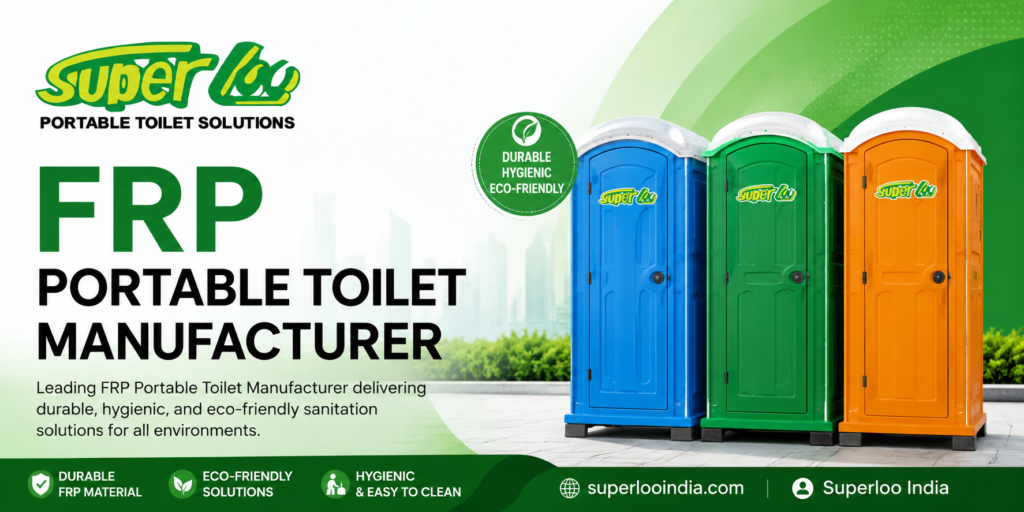
FRP portable toilets come in various forms — standalone cabin units, toilet vans, mobile toilet cabins, and modular blocks. An experienced FRP Toilet Van Manufacturer or FRP mobile toilet cabin supplier will offer customised solutions based on your specific use case.
FRP vs. Other Portable Toilet Materials — Quick Comparison
| Feature | FRP | Standard Plastic (HDPE) | Steel / Metal |
| Durability | Excellent | Good | Very Good |
| Corrosion Resistance | Does not rust | Does not rust | Prone to rust |
| Weight | Lightweight | Very Lightweight | Heavy |
| Ease of Cleaning | Very Easy | Easy | Moderate |
| Cost | Moderate–High | Low–Moderate | High |
| Lifespan | 10–15+ years | 5–8 years | 8–12 years |
Key Factors to Evaluate in an FRP Portable Toilet Manufacturer
So you’ve decided FRP is the right material. Now, how do you find a manufacturer you can actually trust? Here’s what to look for:
1. Manufacturing Experience and Track Record
There’s a big difference between a manufacturer with 2 years of experience and one who has been building FRP mobile toilet cabins for 10+ years. Ask about their project portfolio. Have they worked with government tenders, large events, or construction firms? Longevity in the market signals consistency, quality control, and the ability to handle bulk orders.
2. Product Range and Customisation
Your project might need a simple standalone cabin or a sophisticated toilet van with multiple units, handwashing stations, and ventilation. A good FRP portable toilet manufacturer will offer a wide range of options — from basic single-unit cabins to full-featured FRP toilet van solutions for urban deployments or high-footfall events.
3. Material Quality and Construction Standards
Always ask about the grade of FRP used. High-quality manufacturers use UV-stabilised, anti-corrosive FRP with proper lamination and thickness. The internal fittings — commodes, water tanks, ventilation pipes — should be non-corrosive and easy to replace. Don’t just take their word for it; ask for test reports or certifications where available.
4. Compliance with Sanitation Standards
In India, portable sanitation units used for public projects often need to comply with Swachh Bharat Mission guidelines and other local authority requirements. A credible FRP portable toilet manufacturer will be familiar with these standards and can help you meet compliance without headaches.
5. After-Sales Support and Maintenance
This one is often ignored until something breaks. A toilet unit out in the field needs maintenance — spare parts, occasional repairs, or just expert advice on cleaning routines. Always ask if the manufacturer offers after-sales support, a warranty on the product, and easy availability of spare parts.
Buying Guide Checklist: Questions to Ask Every FRP Manufacturer
| Category | Question to Ask | Why It Matters |
| Experience | How many years in FRP manufacturing? | Ensures reliable quality over time |
| Customisation | Can you build to our site specifications? | One size rarely fits all projects |
| Material | What FRP grade/thickness do you use? | Determines structural strength and longevity |
| Compliance | Do units meet government sanitation standards? | Required for public/government projects |
| Warranty | What warranty do you offer? | Protects your investment |
| Delivery | What are lead times for bulk orders? | Avoids project delays |
| Support | Is after-sales/maintenance support available? | Critical for long-term field deployments |
Step-by-Step: How to Select the Right FRP Manufacturer
Your Selection Process at a Glance
| Step | Action | Goal |
| Step1 | Define your project requirements (size, location, duration, user count) | Know exactly what you need before approaching anyone |
| Step 2 | Shortlist 3–5 FRP portable toilet manufacturers | Compare options rather than going with the first quote |
| Step 3 | Ask for product samples, site visits, or catalogue walkthroughs | Verify build quality in person or through photos/videos |
| Step 4 | Check client references and project history | Confirm reliability and past performance |
| Step 5 | Evaluate pricing, delivery timelines, and warranty | Balance value vs. total cost of ownership |
| Step 6 | Finalise with a written agreement covering specs, delivery, and support | Protect yourself legally and operationally |
Practical Tips for Getting the Best Value
- Always ask for product photos in deployed conditions — a toilet cabin on a muddy construction site tells you more than a showroom photo.
- Don’t buy purely on the lowest price. FRP units that are cheaper often cut corners on thickness, UV protection, or internal fittings — and that costs more in repairs later.
- Request a bulk discount in writing if you’re ordering 10+ units. Most manufacturers have a sliding scale so they don’t advertise upfront.
- Ask about colour and branding options. For events or corporate sites, branded FRP mobile toilet cabins create a better user experience and brand impression.
- Check if the manufacturer ships pan-India or only locally — logistics can add significant cost to your final price.
- Plan for 1 toilet unit per 10–15 workers (for construction sites) or 1 per 50 guests (for events with 4–6 hour duration) as a general thumb rule.
Common Mistakes to Avoid
Even experienced project managers fall into these traps. Here’s a quick table to keep you on the right track:
Do’s and Don’ts When Choosing an FRP Manufacturer
| Do This | Avoid This |
| Ask for physical samples or a factory visit | Placing orders based only on a website catalogue |
| Verify compliance with local sanitation norms | Assuming all units automatically meet standards |
| Compare at least 3 manufacturers before deciding | Going with the first manufacturer you find online |
| Clarify warranty terms in your purchase agreement | Assuming warranty is included without asking |
| Plan your unit count early based on user projections | Under-ordering and scrambling at the last minute |
| Ask about after-sales support and spare parts | Ignoring maintenance planning until something breaks |
Frequently Asked Questions (FAQs)
Q1. What is the difference between an FRP portable toilet and a regular plastic portable toilet?
FRP portable toilets are made using glass fibre-reinforced plastic, which is significantly stronger, more durable, and longer-lasting than standard HDPE or single-layer plastic toilets. They resist cracking, UV degradation, and chemical exposure much better — making them the preferred choice for long-term or heavy-use installations.
Q2. How many portable toilets do I need for a construction site?
A general guideline is one toilet unit per 10–15 workers for an 8-hour shift. For larger sites with multiple shifts or high-traffic zones, you may want one unit per 8 workers. Your FRP portable toilet manufacturer can help you calculate requirements based on your site size and workforce.
Q3. Can FRP mobile toilet cabins be customised for branding or specific layouts?
Yes. Most established manufacturers, including Superloo India, offer customisation options — from exterior colour and logo printing to interior layout changes like adding handwashing stations, urinals, or disability-friendly fittings. Always discuss your requirements upfront before placing an order.
Q4. What is the typical lifespan of an FRP portable toilet?
With proper maintenance, a good-quality FRP portable toilet can last 10–15 years or more. The key factors that affect longevity are FRP grade, lamination quality, how often the unit is cleaned, and whether it’s exposed to extreme weather without adequate care.
Q5. Are FRP toilet van manufacturers different from FRP cabin manufacturers?
Yes, there’s a distinction. An FRP Toilet Van Manufacturer typically mounts multiple toilet units onto a vehicle chassis, creating a mobile sanitation station that can be driven to different locations. An FRP mobile toilet cabin manufacturer produces standalone structures that are transported by truck or crane and placed at fixed locations. Both serve different needs — vans are great for mobility, while cabins are better for semi-permanent installations.
Q6. Does Superloo India supply FRP portable toilets across India?
Yes, Superloo India supplies FRP portable toilets, toilet vans, and mobile sanitation solutions across India. Whether you need units for a government project, an event, a construction site, or a rural sanitation initiative, Superloo India offers pan-India delivery along with after-sales support and customisation services.
Conclusion: Sanitation Is Not an Afterthought
If there’s one thing this guide should leave you with, it’s this — choosing the right FRP portable toilet manufacturer is not just a procurement decision. It’s a statement about how you run your project and how much you value the wellbeing of everyone on it.
The right manufacturer will offer more than just a product. They’ll provide expert guidance, reliable delivery, genuine support, and units that actually perform in the field year after year. And in today’s competitive landscape — where project delays, compliance violations, and worker dissatisfaction can derail even the best-planned operations — that reliability is worth every rupee.
At Superloo India, we’ve spent years engineering FRP portable toilets, toilet vans, and mobile sanitation cabins that are built tough, delivered on time, and backed by real after-sales support. Whether you’re setting up sanitation for 50 workers or 5,000 event guests, we’re here to make sure it’s done right — the first time.
Ready to find the right sanitation solution for your project?
Get in touch with Superloo India today for product specifications, pricing, and expert advice. Because the best project managers don’t leave sanitation to chance.
